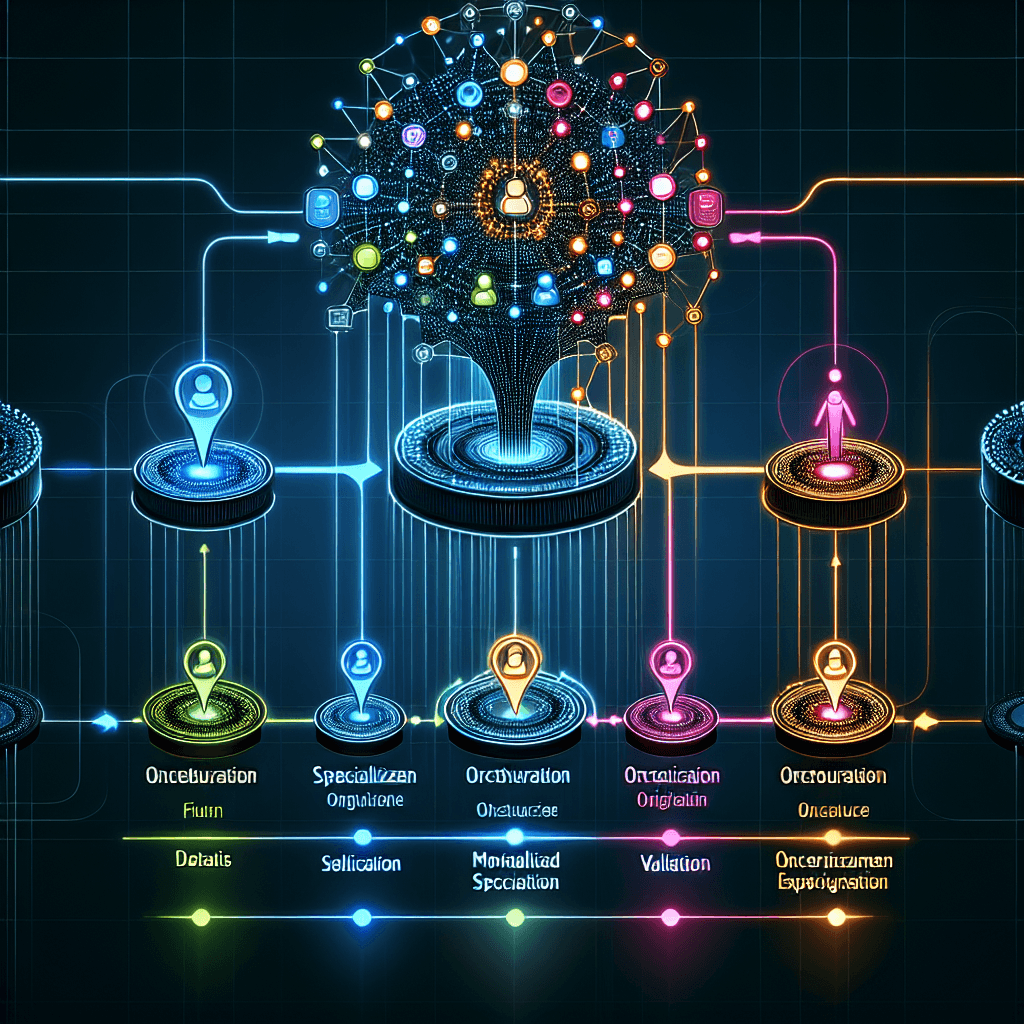
Remember when your monolithic AI agent seemed brilliant in demos but collapsed under production complexity? You're watching it struggle with a fraud detection workflow—first it needs to validate transactions, then cross-reference with historical patterns, pull credit reports, check regulatory compliance, and finally generate an audit trail. Your single agent is trying to be a transaction validator, data analyst, compliance officer, and report generator all at once. The results are brittle, the failures are opaque, and debugging feels like untangling a ball of yarn in the dark.
This pain point is driving the most significant architectural shift in AI systems since the rise of neural networks. The agentic AI field is going through its microservices revolution, with single all-purpose agents being replaced by orchestrated teams of specialized agents. And the data backs this up: Gartner reported a staggering 1,445% surge in multi-agent system inquiries from Q1 2024 to Q2 2025.
The Fundamental Limits of Monolithic AI Agents
Single-agent architectures hit a wall when faced with enterprise-grade complexity. The core problem isn't the underlying models—it's that we're asking one agent to maintain context across wildly different domains, switch between contradictory modes of operation (creative vs. analytical vs. validation), and recover gracefully from failures in any part of a complex workflow.
Multi-agent system architecture addresses this challenge by distributing cognitive load across agents with focused responsibilities. Instead of one generalist drowning in context, you deploy specialist agents that each excel at their specific function.
"Multi-agent systems address fundamental limits of single-agent AI in long-horizon, tool-heavy, enterprise-grade workflows where planning, execution, and validation should be separated."
This separation of concerns isn't just theoretical elegance—it's practical engineering. When your compliance-checking agent fails, it doesn't bring down your entire fraud detection pipeline. When you need to upgrade your data retrieval logic, you swap out one agent without redeploying your entire system. Role-based agent design significantly improves reliability, interpretability, and maintainability in production environments.
What Made 2025 the Turning Point
Multi-agent systems have been discussed in research papers for years, but 2025 marked the shift from academic curiosity to production reality. Two key developments unlocked this transformation:
Standardized Communication Protocols
The breakthrough came with infrastructure standardization. MCP (Model Context Protocol), released by Anthropic in late 2024, became the standard for how agents connect to tools—functioning as USB for AI tools. It provides a standardized way for any agent to discover and use any tool without custom integration code.
In April 2025, Google's A2A protocol addressed the other half of the equation: agent-to-agent communication. This enables peer-to-peer collaboration across different organizations, meaning your fraud detection agent can securely communicate with a third-party credit scoring agent without brittle, custom API integrations.
These protocols did for AI agents what Docker did for microservices—they made the architecture pattern actually viable at scale.
Production-Grade Frameworks
The framework ecosystem matured rapidly. OpenAI's Agents SDK (March 2025) replaced their experimental Swarm framework with a production-grade toolkit using a handoff pattern for agent-to-agent transfer. LangGraph evolved to support complex state machines and conditional routing between agents. CrewAI streamlined the definition of agent roles, goals, and collaboration patterns.
Papers on agentic and multi-agent systems skyrocketed from 820 in 2024 to over 2,500 in 2025, indicating multi-agent systems are now the primary focus for research labs. The tooling caught up with the ambition.
Real-World Results: What Actually Works
The business case for multi-agent architectures isn't speculative. Real deployments show orchestrated systems delivering measurable gains in productivity, error reduction, and scalability compared with manual or single-agent approaches across multiple industries:
BFSI Claims Processing
Insurance companies are deploying specialist agents for document ingestion, claim validation, fraud detection, and settlement calculation. Instead of a single agent trying to understand policy documents while simultaneously evaluating risk, each agent focuses on its domain. The result: faster processing times and fewer false positives that require human review.
Healthcare Diagnostics
Diagnostic workflows use separate agents for patient history analysis, symptom evaluation, medical literature search, and treatment recommendation. This separation ensures that the agent suggesting treatments has access to the most current research without being distracted by patient data retrieval concerns.
Software Engineering
Development teams are orchestrating agents for code review, test generation, documentation, and deployment validation. When your testing agent finds an issue, it hands off to a debugging agent with full context rather than forcing a single agent to context-switch between validation and problem-solving modes.
"Organizations report 30% cost reductions and 35% productivity gains after implementation of multi-agent systems."
Designing Your Multi-Agent Architecture
Making the transition requires strategic thinking, not just swapping libraries. Here's what actually matters:
Start With Task Decomposition
Map your workflow to identify natural boundaries. Look for places where you're currently asking one agent to perform sequential, distinct operations. Each transition point is a candidate for agent handoff. If you find yourself writing prompts like "first do X, then do Y, then validate Z," you're describing a multi-agent system whether you've built one or not.
Define Clear Agent Responsibilities
Each agent should have a focused role with clear inputs and outputs. Avoid the temptation to create "smart" agents that can handle edge cases by doing multiple things. That's recreating the monolith. Instead, create dumb, focused agents and make the orchestration layer handle the complexity.
Design for Observability
The biggest operational advantage of multi-agent systems is debuggability—but only if you instrument properly. Log every handoff, track which agent made which decision, and capture the state at each transition. When something fails, you want to know exactly which specialist agent made the wrong call and what information it was working with.
Implement Graceful Degradation
Not every agent needs to succeed for the workflow to provide value. Design your orchestration to handle partial failures. If your compliance-checking agent times out, can you flag the transaction for human review instead of failing the entire process?
The Trade-offs Nobody Talks About
Multi-agent architectures aren't a silver bullet. They introduce complexity in exchange for solving specific problems. You're trading simple, opaque failures for complex, traceable ones. You're trading one configuration file for an orchestration graph. You're trading a single point of failure for distributed failure modes.
This trade-off makes sense when:
- Your workflow has distinct, sequential phases that require different types of reasoning
- You need to audit which component made which decision
- Different parts of your pipeline need to scale independently
- You're working with tool-heavy workflows where different agents need different tool access
- You need to update parts of your system without redeploying everything
It doesn't make sense when:
- Your task is simple enough that a single agent with a good prompt handles it reliably
- You don't have the infrastructure to manage distributed systems
- Your team doesn't have experience with orchestration patterns
- Your latency requirements are so strict that agent handoffs break your SLA
Looking Forward: The Infrastructure Layer Emerges
We're at the stage where the architecture pattern is proven, but the developer experience is still maturing. The next wave of innovation will be infrastructure: observability platforms purpose-built for agent orchestration, debugging tools that let you replay agent interactions, testing frameworks that can validate multi-agent workflows end-to-end.
The protocols are standardized. The frameworks are production-ready. The results are measurable. The question isn't whether multi-agent architectures will replace monolithic AI systems—it's how quickly your organization will make the transition and what competitive advantage you'll gain by moving early.
"The agentic AI field is going through its microservices revolution—and just like microservices, the winners will be those who understand not just how to build distributed systems, but when to build them."
If you're wrestling with a monolithic agent that's becoming unmaintainable, if you're spending more time debugging prompt interactions than shipping features, if you need to audit AI decisions but can't trace the reasoning—it's time to decompose. Start small: identify one workflow, split it into two specialized agents, and measure the difference. The architecture shift happens one handoff at a time.